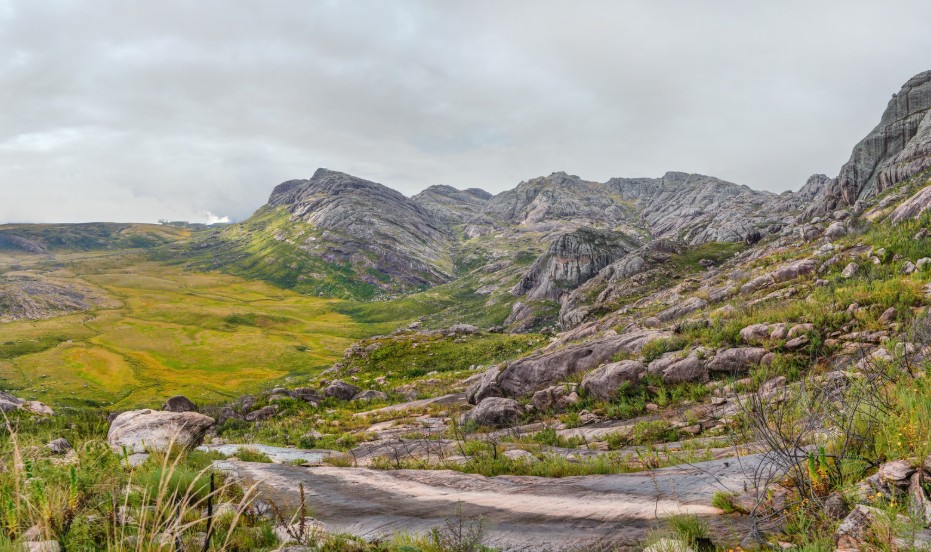
Trek Across Madagascar’s Southern Highlands
15-day tour to include Zafimaniry treks, Ranomafana rainforest, Pic Boby summit, the canyons of Isalo & Ifaty
View tour
Andohahela National Park is one of the few places in Madagascar where three major habitat types meet: eastern rainforest, dry forest and southern spiny forest. Located near Tolagnaro/Fort‑Dauphin, it protects a striking ecological gradient, from humid slopes cloaked in tree ferns to spiny savannas dotted with baobabs and Didiereaceae.
Little visited and quite wild, Andohahela National Park offers an off‑the‑beaten‑track experience for travellers who venture into the south‑east: strong landscape contrasts, lemurs of both humid and dry forests, and a unique transition between the green east and the arid south.
Andohahela National Park lies in the Anosy region, west of Tolagnaro/Fort‑Dauphin, and is divided into several blocks (parcels):
Key features:
Access to different parcels combines 4×4 tracks and hiking, always with a local guide:
Trails can be steep and muddy in the humid block, and very exposed and hot in the dry block.
Thanks to its ecological gradients, Andohahela supports a varied fauna:
The vegetation of Andohahela National Park clearly reflects the east‑west transition:
Less visited than other parks, Andohahela National Park is nonetheless one of the most interesting for understanding the diversity of landscapes in south‑eastern Madagascar. Between montane rainforest and spiny forest, it gives curious travellers a deep immersion into a rare ecological gradient where three of Madagascar’s iconic biomes meet.
Around 40–60 km west of Tolagnaro/Fort‑Dauphin (1.5–2 hours by 4x4 track depending on the parcel), Andohahela National Park is accessed via separate tracks to the Malio and Ihazofotsy–Tsimelahy blocks.
Best from May to October, when conditions are generally drier, tracks more passable and hiking more comfortable, especially in the rainforest block.
From November to April there is heavier rain on the eastern side (muddy, slippery trails) and more heat in the west, but vegetation is lusher and wildlife very active.
Bring sturdy hiking boots: expect steep, muddy trails in Malio and rocky, dusty paths in the dry blocks
Pack a light rain jacket and warm layer for cool, damp rainforest evenings, plus sun protection for the dry side
Carry plenty of water and snacks – services are limited once inside the park blocks